Fix unrecognized or mislocated addresses
By Nathan ColeUpdated
Routing24 geocodes every address to a map point. An address it cannot resolve still imports, but its order cannot be routed. An address that resolves to the wrong point shows no error and sends the driver to the wrong place. Three fixes apply: rewrite the address text, place the pin by hand, or right-click the map.
This page covers finding both cases and each fix.
Find the problem addresses
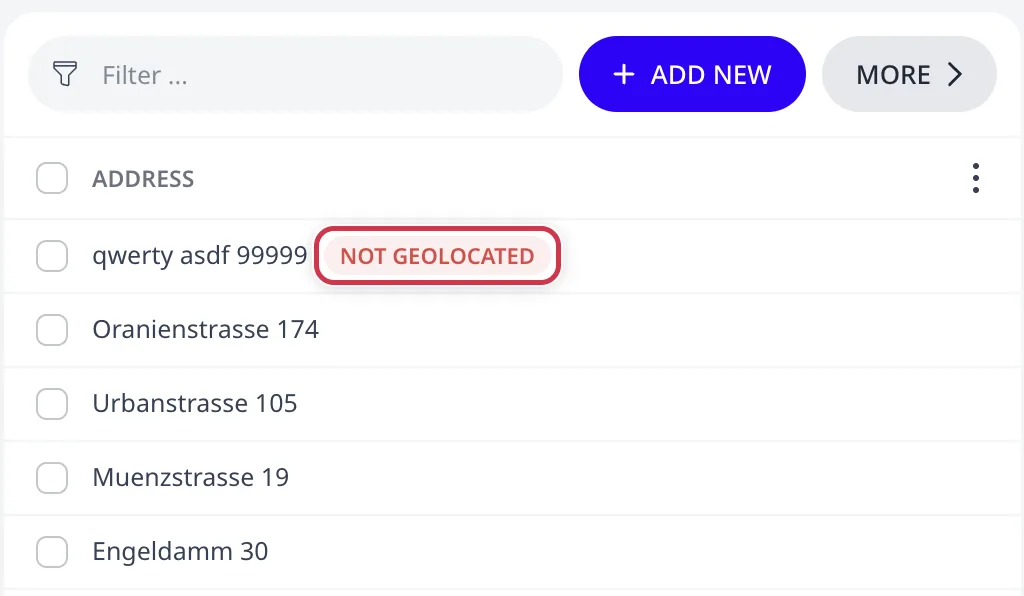
The Address Book page lists every address in the plan with a status: OK for resolved addresses, a red NOT GEOLOCATED badge for addresses without a location.
A mislocated address shows no badge. After an import, check the map: a pin in a river, in the wrong town, or at the exact center of a city (a sign the geocoder matched only the city name) is misplaced.
Fix 1: Rewrite the address text
Most failures come from the address text itself. Hover the row and press its edit action. The address editor opens. Improve the text and pick the right suggestion:
- Remove apartment numbers, company names, and personal names. "Acme GmbH, attn. Meyer, Hauptstr. 5" fails where "Hauptstr. 5" resolves.
- Add a postal code, city or state, and country.
- Find the place on Google Maps™ and copy the address exactly as shown there.
When the pin is correct, press Save address. Every order using that address moves with it.
Fix 2: Place the pin by hand
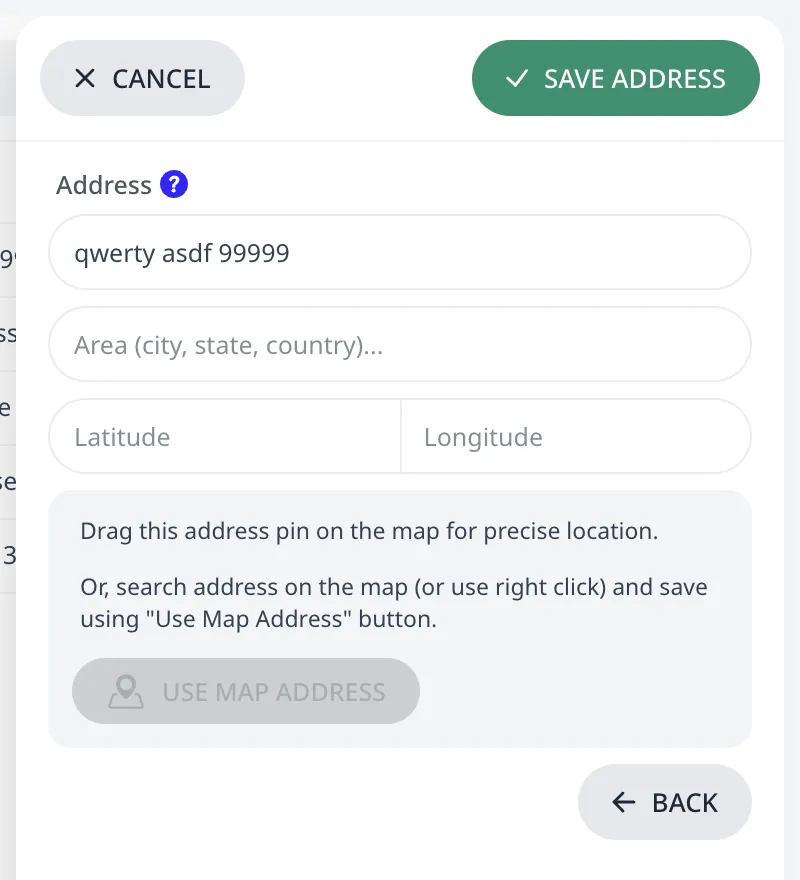
When no address text will resolve (a new development, a field gate, "the third warehouse on the left"), skip geocoding and place the pin by hand in the address editor:
- Drag the pin on the map to the exact spot. Zoom in first. Pin placement is only as precise as the current zoom.
- Or type Latitude and Longitude directly. Pasting a "lat, lng" pair copied from an online map fills both fields at once.
- Or search the place with the map's search box, then press Use map address to adopt the found name, area, and coordinates.
With manual coordinates the address text is a label only and does not need to be resolvable.
Fix 3: Right-click the map
When the correct spot is visible on the map but its address is unknown, right-click the spot on the map. A card opens with the nearest known address for that point:
- Add to addresses saves it to the Address Book as a new entry.
- With an order or address editor open, the button reads Set address instead and fills the editor from the clicked point.
The free tier uses OpenStreetMap-based search and geocoding. The paid tiers use Google Places, which resolves business names, new addresses, and partial input that OpenStreetMap does not. See Plans and billing.
Deleting an Address Book entry also deletes every order and depot using it, and every vehicle using those depots. The confirmation dialog lists everything the deletion removes. Prefer fixing an address over deleting it.
Writing addresses that resolve first time
The pattern that geocodes most reliably is:
street + number, postal code + city, country
Keep names, phone numbers, and delivery notes in other columns, or out of the file. For locations you already know, supply Lat/Lng columns directly: coordinates skip geocoding entirely. Both columns are in the spreadsheet column reference.
Next step
Once every address shows OK, run the optimizer.
FAQ
How do I find orders whose address did not geocode?
Open the Address Book page. The page lists every address in the plan with a status. Resolved addresses show OK. Addresses without a location show a red NOT GEOLOCATED badge. The import review dialog also counts resolved and unresolved addresses before you accept an import, so the number of rows to fix is known in advance.
Why is my pin in the wrong place when the address looks correct?
The geocoder matched part of the text. A pin at the exact center of a city means it matched only the city name. Company names, personal names, and apartment numbers are common causes. Remove them, add the postal code and country, and pick the right suggestion. When no text resolves, drag the pin or enter coordinates.
Can I enter coordinates instead of an address?
Yes. In the address editor, type Latitude and Longitude directly, or paste a lat, lng pair copied from an online map to fill both fields at once. The address text is then a label only and does not need to resolve. In a spreadsheet, supply Lat and Lng columns. Rows with coordinates skip geocoding entirely.
Does fixing an address fix every order that uses it?
Yes. The Address Book keeps one entry per address. Orders and depots refer to that entry. Save a corrected address and every order and depot at that address moves with it. Deleting an entry removes every order and depot using it, and every vehicle using those depots. The confirmation dialog lists everything the deletion removes.