Pickup and Delivery Routing: Six Ways Goods Move and How Long They Stay on Board
Goods are loaded at the depot, returned to it, carried from one customer to another, delivered along a fixed run, or collected at one of several addresses. What each pattern requires from a route optimizer, and why time on board is a limit of its own.
 Nathan Cole||9 min read
You are at the dispatch desk, writing loading and unloading instructions in the notes column beside a van's stops. The planner has an address and a quantity for each visit, but the notes explain where each load belongs.
A planner that treats every job as a stop with a quantity leaves those decisions to you. The stop list alone does not describe the movement of goods or their time on board.
Choose the order pattern before you arrange the route. The sections below follow the goods through each pattern, including what the optimizer needs to check between loading and unloading.
-
Match the order to the work. Choose a pattern that describes the whole job before comparing the routes the optimizer produces.
-
Inspect capacity along the route. Do not approve a mixed delivery-and-collection round from the day's total quantity alone.
-
Review time on board. For sensitive loads, ask how long the consignment travels, alongside whether the driver arrives on time.
Loading and unloading locations
The loading and unloading locations define these six patterns. Start with those locations rather than trying to express every job through a quantity at an address.
| Pattern | Loaded at | Unloaded at |
|---|---|---|
| Depot delivery | the depot | the customer |
| Collection to the depot | the customer | the depot |
| Transfer (pickup and delivery) | one customer | another customer |
| Sequence run | one customer | several later customers, in order |
| Alternative pickup | one of several addresses | the customer |
| Alternative delivery | the depot or a customer | one of several addresses |
Depot delivery is the starting pattern for the vehicle routing problem. Planners generally handle that pattern; support for the other five varies.
Depot deliveries
Depot deliveries cover pharmacy orders, wholesale rounds, parcels, and meals. For an example, take a van that departs at 08:00 with 8 crates for four shops.
The shops receive 2, 3, 2, and 1 crates, respectively. The load falls from 8 to 0 over the round, and the van returns empty.
From the depot.
Departure matters for both space and time, even on this straightforward round. Check these limits before accepting the route:
- If the van holds only 6 crates, the plan needs a second vehicle or a reload, a return to the depot mid-route for the rest.
- For chilled goods loaded at 08:00, the time on board starts at departure. At the 10:00 stop, those goods have already spent two hours in the van.
Collections to the depot
Collections add load during the round. Consider a van collecting empty kegs while delivering boxes to shops:
- Every shop receives 2 boxes and returns 1 keg.
- A keg takes the space of 2 boxes, so a van that departs full stays full after every stop.
To the depot.
Returns, empties, waste, and samples follow this pattern. Recording a quantity without its direction leaves the planner unable to distinguish space that becomes available from space that a collection needs.
The order of loading and unloading determines the peak load. In an example where the driver unloads the deliveries before loading the collections, a route delivers 6 units and collects 9.
Adding those quantities gives 15, but the van never holds more than 9. The delivered units have left the vehicle before the collected units need their space, so the sum describes the day's handling rather than the capacity required.
Customer-to-customer transfers
Flowers collected at a florist and delivered to a hotel occupy space only between those addresses. Courier work, lab samples, patient rides, and stock moves between branches follow the same transfer pattern.
From one customer to another.
A pickup and delivery pair connects the addresses as one job. The optimizer must preserve the relationship while arranging the rest of the route:
- One vehicle serves both ends.
- The pickup comes before the delivery.
- The consignment occupies capacity between the stops and nowhere else.
- Each end has its own time window and service time.
Check the finished route and manual edits against those rules. A feasible stop order still needs to describe a journey the goods can make.
Build one route that collects at a customer and delivers to another. Check whether the plan shows the load after each stop. Then drag the delivery in front of its pickup and inspect what happens. A tool that shows only a route total and accepts that drag does not model goods.
Sequence runs
A sequence run handles parts to job sites or crew runs that need a fixed order. Consider a crew making these visits:
- Collect 4 units of parts at a supplier.
- Deliver 1 at a site survey.
- Deliver 2 at an installation.
- Deliver 1 at a handover.
One pickup, several deliveries in order.
Those four stops belong to one job rather than four independent orders. Entering three transfers would also describe a different movement: the parts collected at the first stop supply the next three deliveries.
The peak load is 4 units, because the optimizer counts the parts on board. Counting 4 at the depot plus 4 on the return would include loads that this run never carries.
For this run, nothing needs loading at the depot and nothing returns to it. The pickup supplies the deliveries exactly; a run with unequal totals needs different load accounting, covered in the FAQ.
Alternative pickups
Alternative pickups let the optimizer choose where to collect the same load. If a part is in stock at two branches, list both addresses on the order instead of deciding which branch the driver must visit.
Collect from one of two addresses.
Each candidate address has its own time window and service time, while the load stays the same at either address. The optimizer selects the branch that suits the route.
For dispatch, the choice concerns the collection location, not the quantity the customer needs. Compare the candidate addresses on their visit requirements rather than treating them as separate collections.
Alternative deliveries
Alternative deliveries let the destination depend on the route. A parcel may go to the customer's door with 5 minutes of service, or to a locker two streets away with 2 minutes of service.
Deliver to one of three addresses.
The optimizer selects whichever destination makes the plan cheapest, and the next optimization may select the other. The same kind of choice can apply to a main entrance or a side entrance.
Alternatives can apply at both ends of a transfer. Allowing collection from either shop as well as delivery to the door or locker gives that single job four combinations, rather than fixing either end before planning.
Time on board
An arrival inside the time window does not guarantee an acceptable journey for the load. Chilled and frozen goods, flowers, blood samples, hot meals, and passengers need a limit on their stay in the vehicle.
A cheapest-route plan may collect early because the pickup is on the way, then deliver late. The resulting arrival can satisfy the customer's window while leaving the goods on board longer than necessary.
A plan constrained by freshness collects as late as possible and delivers as early as possible. The delivery time can stay the same while the time on board becomes shorter.
Time on board.
Compare the pickup timing as well as the arrival when reviewing those plans. An unchanged delivery time can conceal a substantial difference in when the driver first loads the consignment.
Routing24 support
Routing24 includes depot deliveries and collections on every tier, along with capacity and reloads at the vehicle's own depot.
Transfers, sequence runs, alternative locations, and time-on-board limits are Pro features. Pro rules work in full during the 14-day trial of every new account.
For depot work, enter outgoing goods as the order's Delivery load and returning goods as its Pickup load. Routing24 computes the load after every stop and checks the result against vehicle capacity.
Every stop row on the finished route shows its load with an arrow. A down arrow indicates a delivery, and an up arrow indicates a pickup, so the row shows the direction of the load change.
For transfers, the pickup order and delivery order share a transfer id, the identifier that links the pair. Routing24 applies these checks:
- If the pair is infeasible, Routing24 leaves both orders unassigned and gives the reason. The driver does not receive a pickup without its delivery.
- If a drag splits the pair or puts the delivery first, Routing24 flags the edit.
For a sequence run, give 2 to 16 orders one sequence name and a rank each. Routing24 assigns the whole run to one vehicle in rank order, all or none.
The driver may serve unrelated stops between members of the run. The ranks preserve the required order without requiring those visits to sit next to each other on the route.
Routing24 represents alternative locations differently according to the order pattern:
- On plain depot orders, use an alternative group to identify the choices.
- On transfers, supply candidate addresses at either end, up to 8 per end and 16 combinations per transfer.
- Routing24 lists the candidates the optimizer does not select under Alternatives (not chosen).
Routing24 supports time-on-board limits for goods from the depot and for transfers. If no route meets an order's limit, Routing24 leaves the order unassigned and gives the reason.
If a consignment has to change vehicles, enter two jobs and set the timing between them yourself. Routing24 does not move goods between vehicles, whether through a cross-dock or a hand-over between vans mid-route.
FAQ
What is the pickup and delivery problem in route optimization?
Use this model when a pickup and its delivery must stay linked during planning. With time windows, the model is called the pickup and delivery problem with time windows (PDPTW).
With a limit on time on board, the model is called the dial-a-ride problem, used for patient and passenger transport.
What is the difference between a delivery order and a pickup and delivery transfer?
A depot order can have both a Delivery load and a Pickup load. Those quantities describe outgoing and returning goods separately, so they do not have to match.
A transfer connects one pickup to one delivery of the same quantity. Choose according to whether the visits exchange separate loads or carry the same consignment between customers.
How does route optimization handle returns and reverse logistics?
A collection can use space that an earlier delivery frees. If the planner sums every quantity before comparing the result with capacity, the planner can reject a feasible route.
Ignoring collections creates the opposite problem: the plan can overload the van. Check how the planner accounts for the returning load, not just whether the deliveries fit.
Can one pickup supply several deliveries on the same route?
Yes, through a sequence run, including when the collected and delivered totals differ. If later deliveries need more than the run collects, the difference loads at the depot.
If the run collects more than the later deliveries need, the surplus returns to the depot. Account for that difference when reviewing the departure or return load.
What is maximum time on board, and which operations need it?
Maximum time on board limits the interval from loading to unloading. Use the limit when a consignment's condition depends on that interval, as in cold-chain delivery.
For passengers, the same limit is ride time. A distance-only plan may board a rider early and carry the rider past other stops before reaching the appointment.
Can a delivery go to a parcel locker instead of the customer's address?
Yes, by listing the permitted destinations as alternatives for the order. Each delivery address can have its own time window and service time.
Do not treat an unused candidate as an unassigned stop. Only an order that no candidate can serve goes unassigned; a candidate the optimizer does not select is not chosen.
Does the vehicle have to return to the depot between a pickup and a delivery?
No depot visit is required between the transfer's addresses. If the vehicle does reload at the depot along the way, the consignment remains on board and keeps its place in the load.
A reload does not unload that transfer or make its occupied space available for other goods.
The takeaway
Before approving a route, compare the order patterns with the work your drivers must do. Check the movements you otherwise would have explained in the notes column, especially where a pickup supplies a later delivery.
Ask the routing tool to show each consignment's time on board alongside the stop loads. Review both before sending the route to the driver, rather than relying on the order of addresses and arrival times alone.
Keep reading
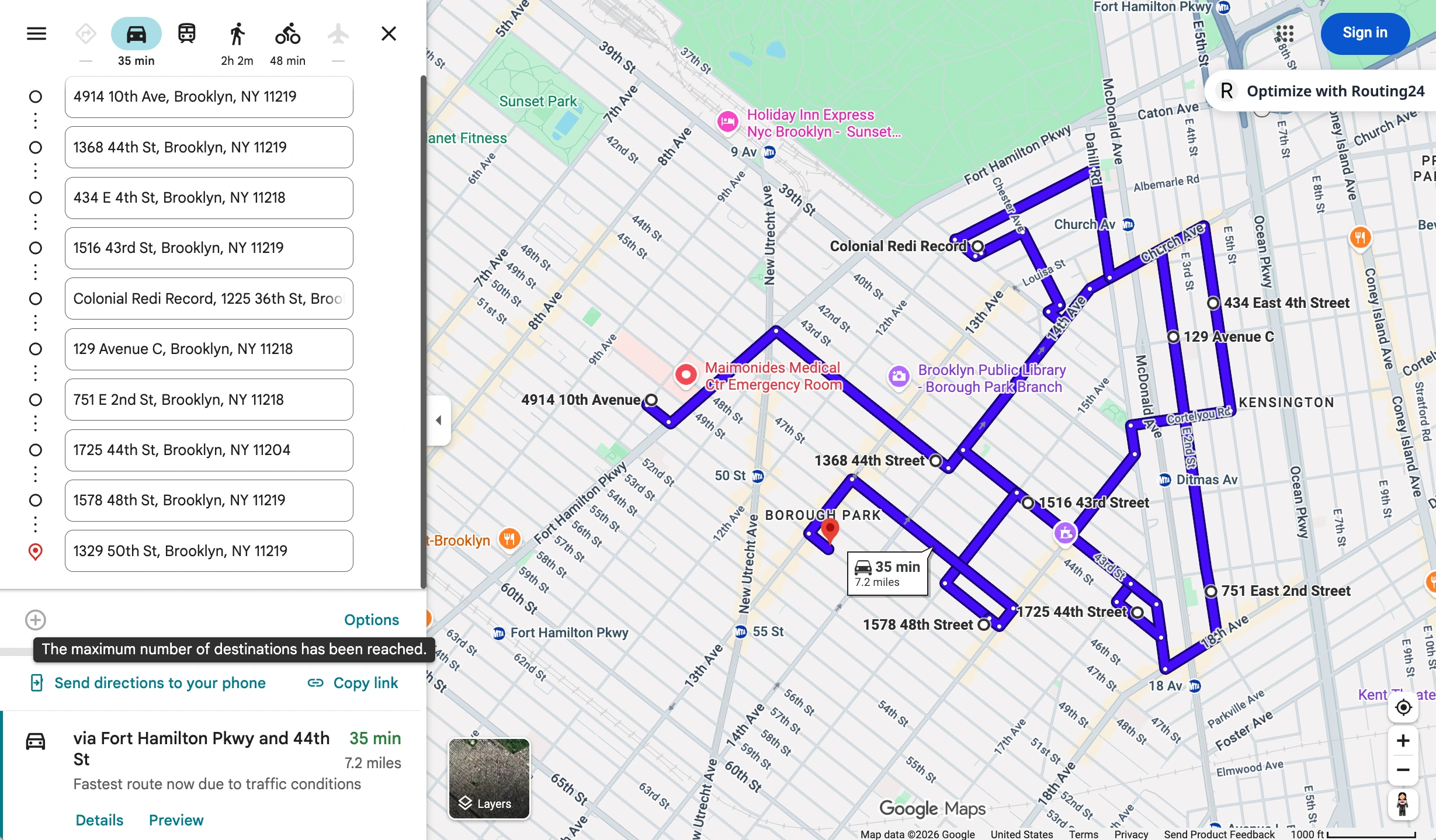
Google Maps Route Optimization: How to Optimize More Than 10 Stops
The 10-stop-per-route limit in Google Maps explained, a free way to overcome it, and how to automatically rearrange your addresses to save time and distance.
AI Route Optimization: What Is Real in 2026
A plain-language guide to artificial intelligence in route planning, the optimization behind the label, and how you divide the work with an optimizer and an assistant.
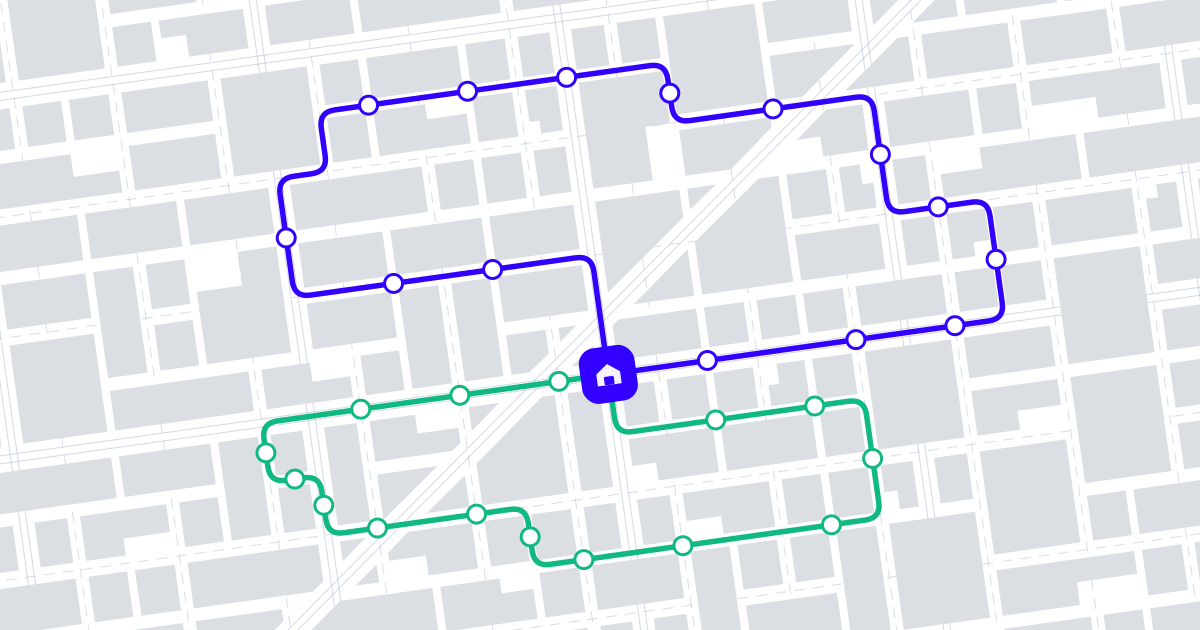
What Is Route Optimization? A Practical Guide for Delivery & Field-Service Teams
Route optimization finds the most efficient set of routes for your whole fleet given real-world constraints. Here is how it works and what it saves.