What Is Route Optimization? A Practical Guide for Delivery & Field-Service Teams
Route optimization finds the most efficient set of routes for your whole fleet given real-world constraints. Here is how it works and what it saves.
 Nathan Cole||8 min read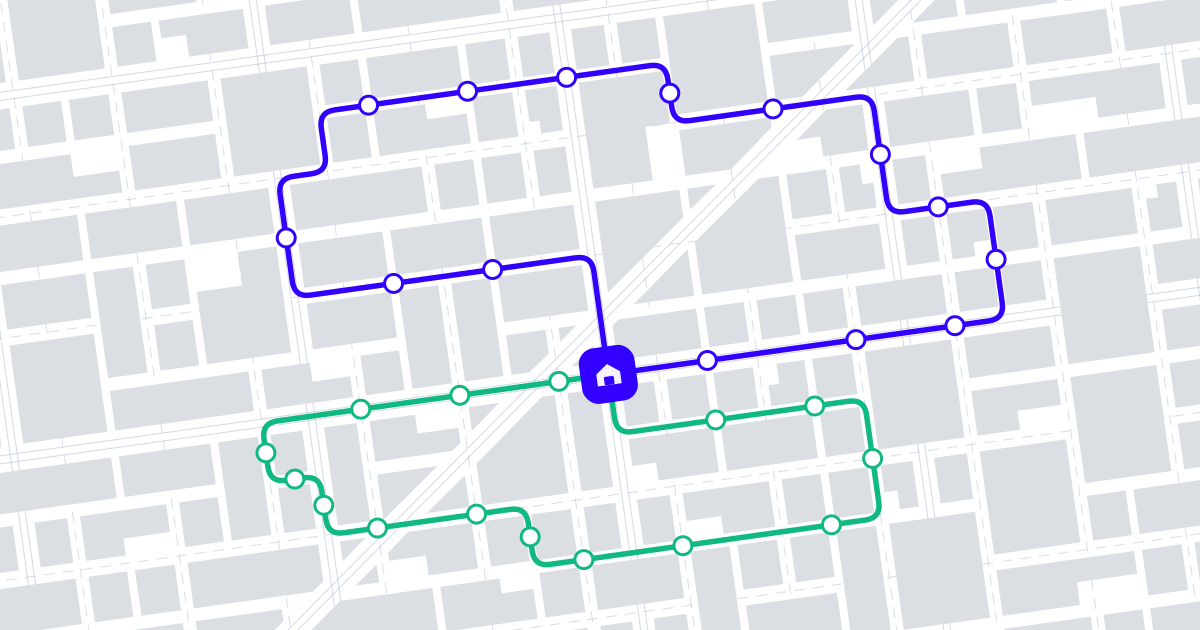
If your team plans routes by hand every morning, you already know the feeling. A pile of stops, a handful of drivers, a whiteboard or a spreadsheet, and a nagging sense that the plan you hand out is "good enough" rather than actually good. Then a customer reschedules, a van breaks down, and the whole thing needs reshuffling before the first driver has even left the yard.
Route optimization is the software answer to that problem. This guide explains what it actually is, how it works in plain language, and what the savings really look like once you separate the well-documented numbers from vendor marketing.
-
Two decisions at once. It assigns every stop to a driver and orders each route across your whole fleet, not one trip at a time.
-
Your real rules, respected. Time windows, vehicle capacity, and driver shifts are built in, and routes rebuild when the day changes.
-
Documented savings. Expect 10 to 30 percent less driving and 25 to 75 percent less planning time. Be skeptical of any guaranteed number.
What route optimization means
Route optimization is the process of finding the most efficient set of routes and vehicle assignments for your entire fleet at once. It minimizes total time, distance, or cost while honoring the real-world constraints your operation runs on, like delivery time windows, vehicle capacity, and driver shifts.
It answers two questions together, not one:
- Who serves which stops (how the day's work is split across drivers), and
- In what order each driver visits them.
That "set of routes, all at once" part is what makes it different from the tools it gets confused with:
- Route planning charts a feasible sequence of stops. It produces a plan that works. It does not search for the best one.
- A maps app finds the fastest path between stops you have already ordered. One vehicle, a fixed sequence, no fleet-level constraints.
Optimization is the only one of the three that decides the assignment and the order together, across every vehicle, while respecting your rules. That is also why it is the only one that meaningfully lowers cost across a fleet.
See the idea in one click

Same eight stops, same vehicle, a shorter route just from a smarter visiting order. A single route rarely moves the needle on its own. The point is what happens when you apply that to dozens of drivers and hundreds of stops, every single day. Small per-route savings compound into real money and real hours over a week, a quarter, a year.
Why it is hard to do by hand
The catch is the sheer number of combinations. Every way to split stops across drivers and put them in order is a different plan, and that number explodes as you add stops. One more stop does not add one more choice, it multiplies them. A single day's work has more possible plans than anyone could weigh on a whiteboard, so past a handful of stops and a couple of drivers, planning by hand quietly leaves time and money on the table.
This is what software is for. It searches that huge space of routes in seconds and gets very close to the best plan there is, then does it again every morning without the headache.
Constraints real fleets care about
The difference between a toy demo and a tool you can run a business on is how many of your rules it can honor at once. A practical optimizer should handle:
- Time windows. Delivery and appointment slots, plus "do not arrive before" and "must finish by" limits.
- Vehicle capacity. Weight, volume, pallet count, or units, sometimes several of those at once.
- Driver shifts, hours, and breaks. Legal limits, paid hours, and mandatory rest, so a route a human cannot actually complete never gets dispatched.
- Service time per stop. Five minutes for a parcel drop versus forty for an install changes the whole plan.
- Skills, zones, and compatibility. A refrigerated load needs the right van, a gas install needs a certified tech, and some customers belong to a specific territory.
- Real travel times and traffic. Actual road network times and time-of-day patterns, not straight-line distance.
- Multiple depots and start or end points. Drivers who begin or end at home, or pull from more than one warehouse.
How modern route optimization works (high level)
You can think of any optimizer as three stages.
1. Inputs. You provide the raw material:
- Geocoded stops (addresses turned into precise coordinates).
- Vehicles and their capacities.
- Driver shifts, working hours, and breaks.
- Time windows and service durations.
- One or more depots and start or end locations.
- Real travel times, ideally traffic-aware.
2. The optimizer. This is where the software does its work, exploring a huge space of possible routes, keeping what improves the plan and discarding what does not, refining until the clock or a quality target says stop.
Here is the honest framing that matters: at real-world scale, nobody finds the single perfect set of routes. What good software does is reliably land within a few percent of the best plan possible, in seconds rather than the hours or days that checking every option would take. For an operations team, "near optimal in seconds, every morning" beats "perfect, never" by a wide margin.
3. The output. Balanced, ordered, driver-ready routes that respect every constraint you set, usually with per-stop arrival estimates. Crucially, modern tools also support live re-optimization: when a customer reschedules, a vehicle drops out, or a rush order lands at 11am, the system can recompute the remaining work on the fly rather than forcing a manual redo.
You do not have to model every rule on day one. Begin with the constraints that hurt most today, often time windows and capacity, get clean routes out the door, then layer in skills, breaks, and multi-depot logic as you go. An optimizer you actually use beats a perfect model you never finish configuring.
What route optimization actually saves
This is the section where it pays to be careful, because the internet is full of confident numbers with no source behind them. Here is what is genuinely well-documented, and what to treat as a range rather than a promise.
The strongest public example is UPS and its ORION system. Per INFORMS, ORION's route optimization saves UPS roughly 100 million miles and about 10 million gallons of fuel every year, an estimated $300 to $400 million annually. That is a single large enterprise, so do not extrapolate it to a ten van fleet, but it shows the ceiling when optimization is applied at scale.
It also helps to know where the cost sits. According to Capgemini (2019), last-mile delivery accounts for about 41% of total supply chain costs. That is the largest single chunk, which is why squeezing inefficiency out of the last mile is so valuable.
Last-mile delivery is roughly 41% of total logistics cost. It is the most expensive leg of the journey, and the one route optimization touches most directly.
For your own fleet, here is what providers typically report as outcomes. Treat these as a range the industry sees, not a guarantee for your operation:
- Roughly 10% to 30% less mileage, fuel, and drive time.
- Roughly 25% to 75% less time spent planning routes each day.
Your actual results depend on your stop density, how tight your constraints are, and how much slack your manual process leaves on the table. There is also a quality dividend that is harder to put a single number on: a failed delivery is expensive (a redelivery, an unhappy customer, sometimes a refund), and tighter, more accurate arrival estimates reduce missed and failed stops.
"Save 30%, guaranteed" and "$X ROI for a 50-vehicle fleet" are sales claims, not facts. The UPS ORION figures and the 41% last-mile share are sourced and citable. Per-fleet savings are a range that depends on your data and your constraints. Ask any vendor to run a pilot on your real stops before you believe a specific number.
Choosing route optimization software
When you evaluate tools, work down a short checklist rather than chasing feature counts:
- Does it cover your constraint mix? Match it against the list above. The one constraint it cannot model is the one that will force manual fixes forever.
- Solve speed and live re-optimization. Can it produce routes fast, and recompute when the day changes, not just plan once overnight?
- Easy setup, import, and geocoding quality. How quickly can you load your stops, and does it turn messy addresses into accurate coordinates? Bad geocoding quietly poisons every route.
- Driver app and customer ETA notifications. Drivers need turn-by-turn navigation and a way to capture proof of delivery. Customers increasingly expect an accurate arrival window.
- Integrations. Does it connect to your order, ecommerce, or dispatch system, or will someone be copy-pasting spreadsheets?
- Pricing and scalability. Does the cost model fit your fleet size today and the size you are growing into?
FAQ
What is the difference between route planning and route optimization?
Route planning produces a single feasible plan: a workable order of stops. Route optimization searches across many possible assignments and orderings to find the most efficient feasible plan for the whole fleet, weighing time, distance, cost, and your constraints together. Planning gives you a plan. Optimization gives you a good one.
Why not just use Google Maps™?
A maps app is built for one driver following an order you already decided. It will not split a few hundred stops across a dozen vans, respect delivery time windows or vehicle capacity, account for driver shifts and breaks, or rebalance the day when something changes. Those fleet-level decisions are exactly what route optimization exists to make.
How much can route optimization actually save?
At enterprise scale, UPS's ORION system saves roughly 100 million miles and about 10 million gallons of fuel a year, an estimated $300 to $400 million (INFORMS). For an individual fleet, providers typically report on the order of 10% to 30% less mileage and drive time, and 25% to 75% less planning time. Those are ranges, not guarantees, so a pilot on your own stops is the only way to know your number.
Does it handle time windows and driver breaks?
Yes, a capable optimizer treats both as hard constraints. It schedules each stop inside its allowed window and builds routes a driver can finish within a legal shift, including mandatory breaks, so you do not dispatch a plan that looks great on paper but cannot actually be completed.
What is dynamic re-optimization?
Dynamic, or live, re-optimization is recomputing routes mid-day as reality shifts: a customer reschedules, a vehicle goes offline, or an urgent order comes in. Instead of manually reshuffling the board, the system re-solves the remaining work and updates the affected drivers, keeping the plan optimal as the day unfolds.
The takeaway
Manual planning gets you a plan. Route optimization gets you a good plan for the whole fleet, in seconds, with your real constraints baked in. The savings are real and well-documented at the top end, and consistently meaningful for everyday fleets, as long as you judge any tool on your own data rather than someone else's headline number.
The quickest way to feel the difference is to see what optimized routes look like on your own stops.
Keep reading
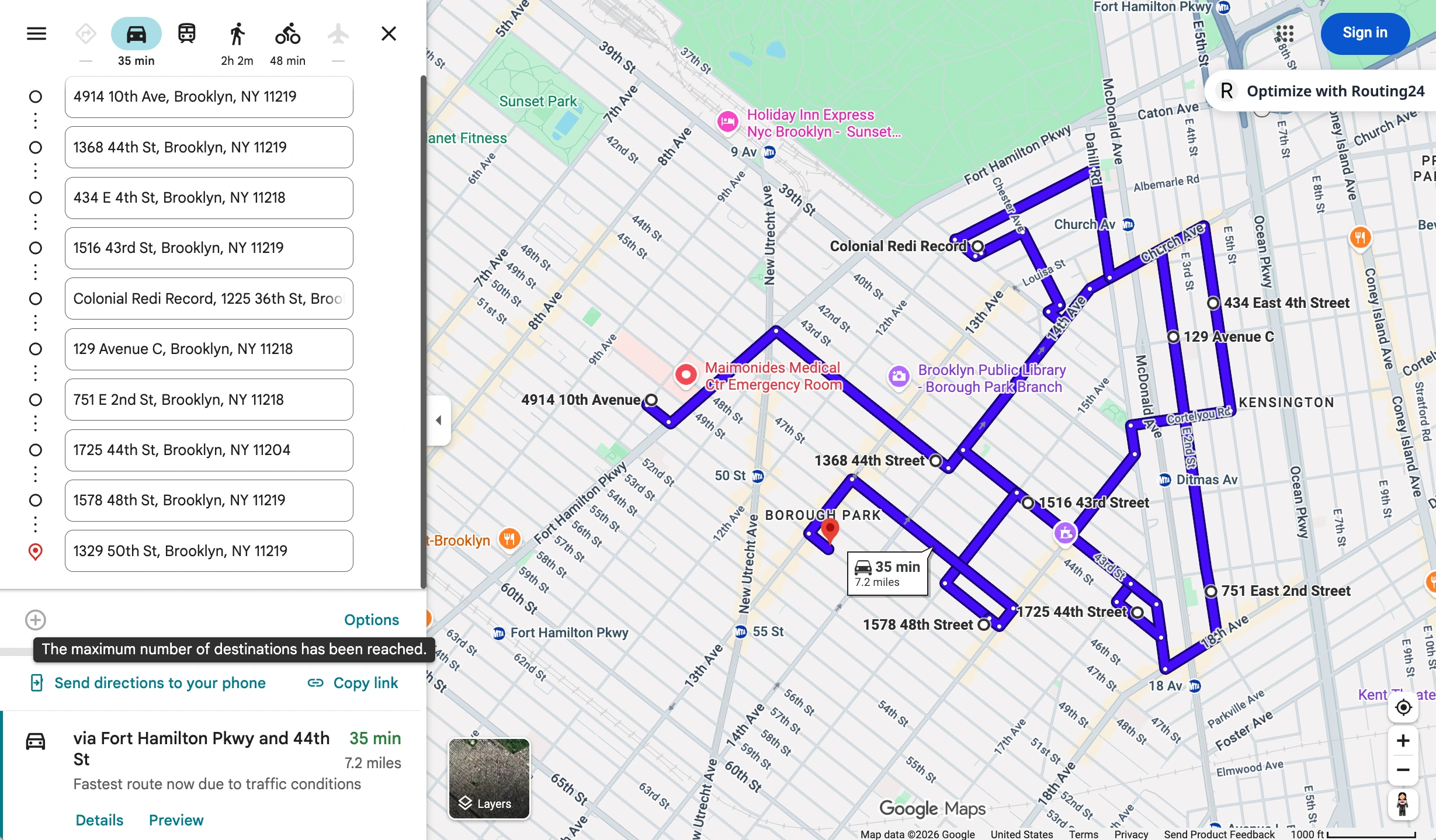
Google Maps Route Optimization: How to Optimize More Than 10 Stops
The 10-stop-per-route limit in Google Maps explained, a free way to overcome it, and how to automatically rearrange your addresses to save time and distance.
Pickup and Delivery Routing: Six Ways Goods Move and How Long They Stay on Board
Goods are loaded at the depot, returned to it, carried from one customer to another, delivered along a fixed run, or collected at one of several addresses. What each pattern requires from a route optimizer, and why time on board is a limit of its own.
AI Route Optimization: What Is Real in 2026
A plain-language guide to artificial intelligence in route planning, the optimization behind the label, and how you divide the work with an optimizer and an assistant.