The Hidden Costs of Route Optimization Software
The sticker price is rarely the real price. A plain-language guide to per-seat, per-stop, and per-order pricing, where the hidden costs hide, and how the main vendors compare as of mid-2026.
 Nathan Cole||8 min read
Comparing route optimization tools by their headline price is like comparing flights by the fare before bags, seats, and taxes. The number on the pricing page is the start of the conversation, not the bill. Two tools that both advertise "from $49" can land hundreds of dollars apart once you add the drivers, the stops, the text messages, and the features that turn out to be a paid extra.
This is a plain-language guide to how route optimization is actually priced, where the costs hide, and what the main vendors charge as of mid-2026. We include our own pricing too, and we have tried to be fair rather than flattering: every model below fits some business well. The trick is knowing which shape is yours.
Three pricing models, three very different bills
Almost every tool in this market uses one of three models. Before you compare prices, work out which one you are looking at, because they scale on completely different things.
- Per seat (per user or per driver). You pay for each person who touches the system: drivers, dispatchers, sometimes managers. The bill grows when your team grows, regardless of how many stops you run. OptimoRoute, Upper, and Track-POD work this way, and Route4Me is reported to.
- Per volume (per stop, per task, or per order). You pay for the work, not the people. Drivers are usually unlimited. The bill grows with your stop count, which is wonderful in a quiet month and painful in a peak one. Routific, Onfleet, and Circuit's team product price this way.
- Flat. One price for the plan, regardless of seats or stops within it. Predictable, and adding a van or a dispatcher does not move it. This is how we price Routing24.
If you are people-heavy and volume-light (a field-service team doing a few high-value jobs each), per-volume pricing is your friend. If you are volume-heavy and run a lean office (lots of small deliveries, few dispatchers), per-seat pricing flatters you and per-volume can bite. Flat pricing is the hedge when you are not sure, or when you want a number you can forecast.
How the main vendors compare (mid-2026)
Published starting prices, the model each uses, and whether there is a free way in. These are entry-tier figures, most discounted rates assume annual billing, and prices change often, so treat this as a map and confirm the current number before you buy.
- Routing24Flat per account$0 free plan; Starter $69/mo; Pro from $199/mo — unlimited users, vehicles and stops on every tierFree plan, no card
- RoutificPer orderFirst 100 orders/mo free, then $150/mo to 1,000 ordersFree tier + trial
- OptimoRoutePer driverfrom ~$35/driver/mo (billed annually)30-day trial
- UpperPer userfrom ~$40/user/mo (billed annually)7-day trial
- Track-PODPer driver (min 3) or per orderfrom ~$49/driver/mo (billed annually)Free trial
- OnfleetPer taskfrom $619/mo (2,500 tasks)14-day trial
- Circuit (Spoke Dispatch)Per stopfrom ~$100–$125/mo (about 1,000 stops)Free solo app
- Route4MePer user, quote onlyNot published (reported from ~$199/user/mo)Trial
A few honest caveats. Route4Me does not publish prices at all, so its figure is a third-party report, not a quote. Circuit's team product (now called Spoke Dispatch) had inconsistent tiers across sources when we checked, so treat its number as approximate. And every "from" is an entry tier: the plan most growing businesses actually need usually sits a step above it.
Where the hidden costs hide
Here is the part the pricing page underplays. These are the line items that turn a tidy headline into a surprising invoice, and they are well documented across the category.
Text messages are almost always extra
Customer SMS notifications ("your driver is 3 stops away") are one of the most loved features and one of the most reliably un-bundled ones. They are metered per message, often priced by country, and billed after the fact. Several vendors include email notifications for free and charge for SMS specifically. If you send arrival texts at any volume, price that line separately, because it does not show up in the headline.
Per-volume plans have overage fees
On per-stop, per-task, or per-order plans, the included allowance is a ceiling, not a promise. Go over it and you pay per unit on top, and a busy season is exactly when you blow through the cap. A plan that looks comfortable in February can run well above its sticker in December. Always size the plan for your peak month, not your average one.
"Advanced optimization" and live tracking can be gated
It is worth checking that the actual route optimization (not just route planning) is in the tier you are pricing. On some platforms the strong optimizer, live customer tracking, capacity planning, or barcode scanning are higher-tier features or per-driver add-ons. Live tracking billed per driver, for example, quietly adds up across a fleet.
On per-seat plans, every user counts
The per-seat headline is per seat, and a seat is often any account: each driver, each dispatcher, sometimes each manager. A "$45 per user" tool for four drivers and two dispatchers is six seats, not one price. On some platforms the driver mobile app is its own subscription on top. The number to compute is seats times rate, plus add-ons, not the headline.
Most of the attractive per-seat rates assume you pay for a full year up front. The monthly rate is typically higher, sometimes by 10 to 20 percent. Some tools also set a floor: a minimum number of seats or drivers before you can subscribe at all. A genuinely small operation can find the "starter" plan is larger than it needs.
Quote-only pricing has its own cost
When a vendor hides pricing behind "contact sales," the cost is your time and your leverage. You cannot compare quickly, you cannot forecast, and you negotiate without a public anchor. That is a real cost even before the contract, and it is worth weighing against tools that simply publish a number.
Setup and onboarding on larger deployments
At the small-business tier, most tools have no setup fee, and a few include onboarding. As deployments grow, third-party implementation and customization fees appear, sometimes from a few hundred to several thousand dollars. If a sales process steers you toward "implementation," get that number in writing alongside the subscription.
A worked example, by model not by brand
Picture a small fleet: four vans, two dispatchers, and about 5,000 stops a month. Here is how the shape of each model plays out. These are illustrative, not quotes, to show how the bill behaves rather than to pin a price on any one vendor.
- Per seat. Four drivers plus two dispatchers is six seats. At an illustrative $45 per seat that is $270 a month before add-ons, and live tracking or capacity planning may be billed per driver on top. Hire a fifth driver and the bill rises even if your stop count does not.
- Per volume. 5,000 stops against a plan with, say, a 2,500-task allowance means you pay the base plus overage on the next 2,500, which can land well above the headline. Drivers are usually unlimited, so this is kind to seat-heavy teams and harsh in a peak month.
- Flat. One plan price covers the seats and the stops within it. Adding the fifth driver or a busy week does not change the number, which is the whole point if you are forecasting a year ahead.
None of these is "the cheapest" in the abstract. The cheapest is the one whose scaling axis (people or volume) you have least of.
Where Routing24 fits
We will be straight about our own bias here. Routing24 is priced flat, per account, not per seat or per stop, and the free plan already does unlimited stops, vehicles, and plans with real optimization, not a 10-stop demo. Paid plans add dispatching to a driver app, Google Maps™ and geocoding, and advanced constraints, at $69 and from $199 a month. There is no per-stop overage to blow through and no per-seat multiplication as you hire.
That model is not automatically right for everyone. If you need a deep, white-glove driver app ecosystem, heavyweight enterprise integrations, or features another vendor specializes in, weigh that honestly. But if you want optimization you can try for free and a bill you can predict, flat pricing is hard to beat, and you can run your own stops through it before you pay anything.
Before you sign, build your real monthly number for each tool: (seats times rate) or (stops times rate including overage), plus SMS at your real volume, plus any per-driver add-ons, on your peak month. The ranking you get from that almost never matches the ranking of the headline prices.
A short checklist before you buy
- Which axis does it scale on, people or volume, and which do you have more of?
- Is real optimization in the tier you priced, or a step up?
- What do arrival texts cost at your actual monthly volume?
- What is the overage rate, and what does your peak month look like against the allowance?
- Monthly or annual, and is there a seat or driver minimum?
- Can you trial it on your own stops before committing?
FAQ
Why do route optimization prices vary so much?
Because they measure different things. A per-seat tool and a per-task tool are not really priced in the same units, so their headline numbers are not directly comparable. You have to convert both to your monthly cost on your fleet shape before the comparison means anything.
Is per-stop pricing better than per-seat?
Neither is better in general. Per-stop (per-task, per-order) pricing favors teams with few dispatchers and lots of small jobs. Per-seat favors teams with high job value and a lean office. The wrong one for your shape is where the bill surprises you.
What is the most commonly overlooked cost?
Customer SMS notifications. They are popular, usually un-bundled, metered per message, and billed after the fact, so they rarely appear in the comparison and often appear on the invoice.
Does a free plan mean the tool is limited?
It depends on the vendor. Some free tiers are a tight demo (a handful of stops). Others, including Routing24's, run real optimization on unlimited stops and vehicles, with paid plans adding dispatch and advanced features rather than unlocking the core. Check what the free tier actually does before you judge it.
Sources and method
Figures above were drawn from each vendor's published pricing where available, checked in mid-2026: Routific, OptimoRoute, Upper, Track-POD, Onfleet, and Circuit's Spoke Dispatch. Route4Me does not publish pricing; its figure is a third-party report. Pricing models and the "hidden cost" patterns (metered SMS, overage fees, tier-gated features, seat math, annual lock-in) are documented across these vendors' own pages and independent reviews. Prices change frequently, so confirm the current number with the vendor before deciding.
The takeaway
The honest comparison is not headline against headline. It is your monthly cost against your monthly cost, computed on your real seats, your real stops, your real text volume, and your peak month. Work out which axis each tool scales on, add the line items the pricing page leaves quiet, and the cheapest sticker frequently stops being the cheapest tool. When you would rather not do that math every renewal, a flat plan you can try for free is the simplest way to know exactly what you will pay.
Keep reading
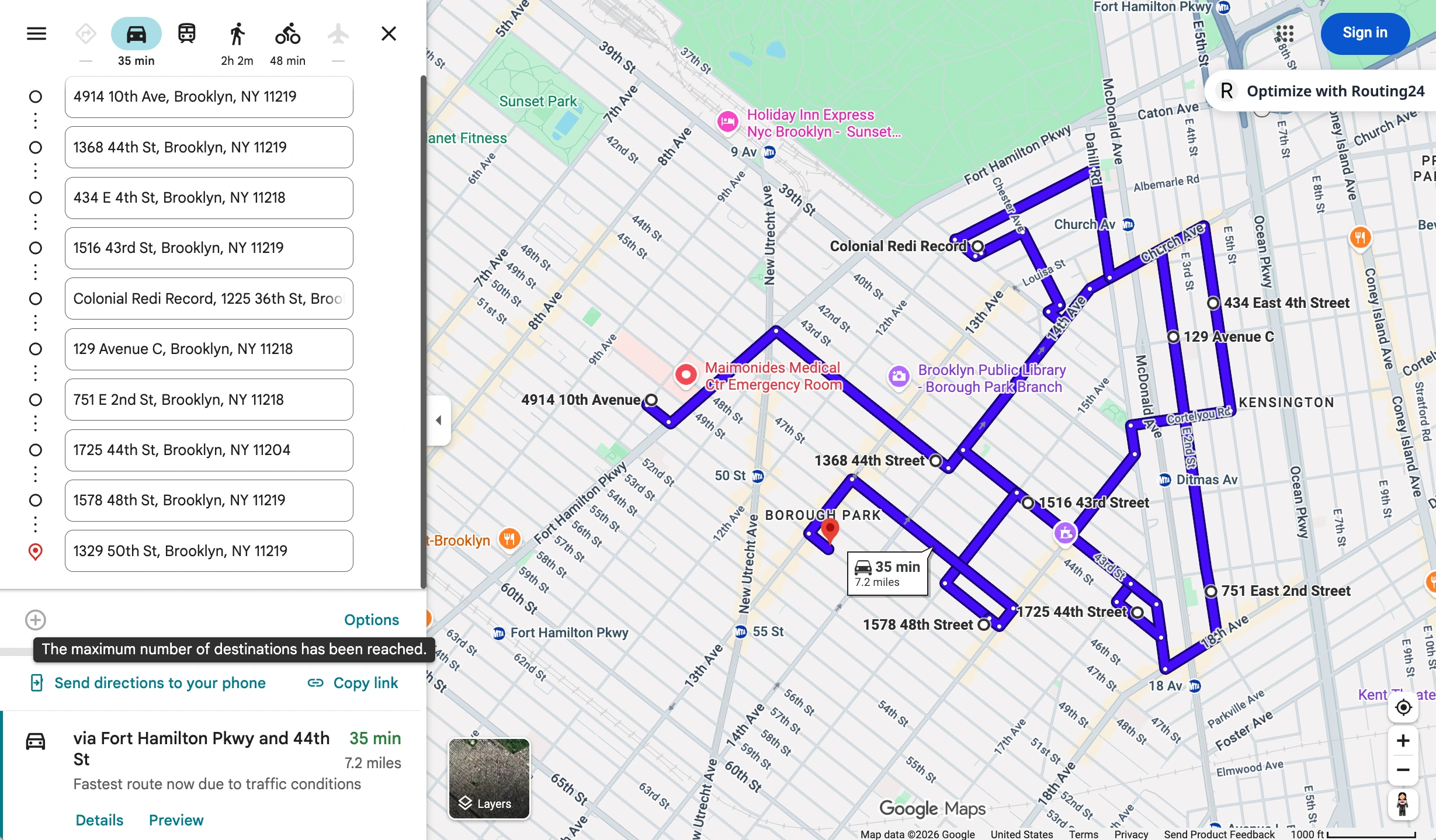
Google Maps Route Optimization: How to Optimize More Than 10 Stops
The 10-stop-per-route limit in Google Maps explained, a free way to overcome it, and how to automatically rearrange your addresses to save time and distance.

Pickup and Delivery Routing: Six Ways Goods Move and How Long They Stay on Board
Goods are loaded at the depot, returned to it, carried from one customer to another, delivered along a fixed run, or collected at one of several addresses. What each pattern requires from a route optimizer, and why time on board is a limit of its own.
AI Route Optimization: What Is Real in 2026
A plain-language guide to artificial intelligence in route planning, the optimization behind the label, and how you divide the work with an optimizer and an assistant.